After returning home from CrowdRiff Converge, I’m convinced we have reached an inflection point: AI is no longer an add-on to social media. It is becoming the architecture beneath it.
Across three days, destination leaders and the brilliant minds behind CrowdRiff shared how generative intelligence is transforming not just productivity, but creativity, discoverability, and digital storytelling.
Here are the most practical and transformative takeaways for those of us working at the intersection of travel, storytelling, and social media.
1. Social Media Is Becoming a System, Not a Stack
Social media used to be a chain of disconnected tools: planners, spreadsheets, analytics dashboards, and CRMs. Now, it is evolving into an intelligent ecosystem where AI connects content creation, data interpretation, and audience interaction.
Teams at Converge shared how Notion AI, Fireflies.ai, and Fathom now automate everything from meeting transcription to multi-platform summaries. These tools allow teams to query their own meeting archives like searchable memory banks.
One destination uses Fireflies to summarize partner meetings and automatically push action items into Asana. Another integrates Notion AI with Google Drive to produce weekly summaries that feed directly into campaign calendars.
Practical Actions
- Replace scattered tools with Notion 3.0 which now integrates docs, email, and calendars.
- Use AI summaries to feed insights directly into your content calendar.
- Connect tools with Zapier or explore Model Context Protocol (MCP) integrations to automate data flow between systems.
💡The next frontier isn’t about posting faster. It’s about designing context continuity. The more structured and connected your data, the more intelligent your content decisions become.
2. AI Is Redefining Creativity
Generative AI is becoming the ultimate creative collaborator. Teams are using it to simulate audience reactions, test tone and headlines, and even visualize design direction before production.
At Converge, Gemini 2.5 Flash (nicknamed “nanobanana”) was highlighted as a breakthrough tool. It merges text and image understanding, making it possible to describe visuals conversationally. Instead of typing “wide-angle photo of a sunset,” you can simply say, “Add sconces to this wall,” and the model understands placement, lighting, and context.
But the discussion didn’t stop at prompting. It expanded to how photo and video creation itself are being redefined:
- AI-assisted visual planning allows teams to storyboard campaigns in minutes, mock up ad sets, or map out a Reel concept using rough descriptions.
- AI editing tools like Runway, Pika Labs, and Descript are streamlining post-production by removing background noise, upscaling footage, fixing lighting, and even generating B-roll that matches your brand tone.
- Photo organization and search are becoming intelligent. CrowdRiff previewed how AI tagging within their platform automatically categorizes photos by emotion, setting, and subject, making it easier for social teams to find “the right image, right now.”
- Accessibility and inclusion are advancing too. AI-generated alt text (also available through CrowdRiff) and automated captioning are improving reach for differently abled audiences.
One DMO used Gemini to storyboard a “Winter Weekend Itinerary” carousel and maintain their brand color palette and typography. Another used ChatGPT to generate ten caption options, then analyzed each through sentiment scoring to select the top performer.
Practical Actions
- Use Canva Magic Write or Adobe Firefly for visual ideation.
- Build a Custom GPT to embed your brand voice and tone for consistent copy.
- Test multiple creative versions of captions or visuals and analyze engagement data to see what resonates.
- Leverage CrowdRiff for automated tagging, smarter image search, and visual asset curation.
💡The new creative stack combines AI, human intuition, and performance data. Creativity is becoming an iterative and predictive process rather than a linear one.
3. Discovery Has Gone Conversational
The traditional funnel (awareness, click, conversion) is collapsing.
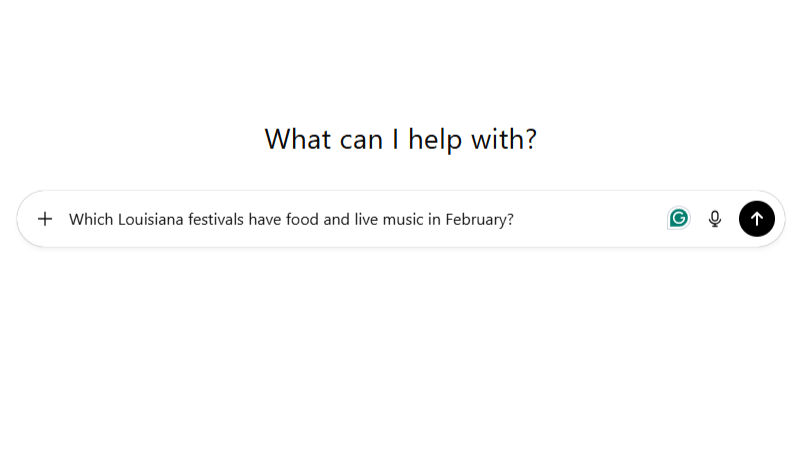
Travelers are no longer searching through feeds or typing into Google. Today, people are asking Gemini, ChatGPT, or Perplexity:
“Where should I go for a weekend trip with my dog?” “Which Louisiana festivals have food and live music in February?”
These models now surface Instagram Reels and TikToks within their answers. Your captions are now data points in AI discovery.
Social content is being parsed, indexed, and summarized by algorithms to determine authority, tone, and relevance.
Practical Actions
- Write captions as if answering a search query: “Here’s where to eat, stay, and play in Southwest Louisiana.”
- Use clear context markers: location, partner tags, accessibility notes, and event details.
- Keep posts updated, as outdated content still circulates in AI results.
- Structure captions in a conversational Q&A format that mirrors how people ask questions in chat.
- Use human language. AI models still rely on clear syntax and keywords.
💡Social captions are no longer just storytelling. They are metadata. Each post must serve two audiences: the human reader and the machine interpreter.
4. Zero-Click Social and the Machine Audience
One of the most important discussions at Converge centered on “zero-click social.”
Website traffic may decline, but discovery and engagement are happening directly inside AI platforms like Gemini and ChatGPT. As one speaker said, “Traffic might drop, but conversions and brand visibility are happening upstream.”
Destinations such as Travel Manitoba & Cody Chomiak, CDME are tracking Share of AI Voice, measuring how often their destination appears in AI-generated answers compared to competitors.
They are also partnering with authoritative publishers like Lonely Planet to refresh old content that AI models reference.
Practical Actions
- Audit your brand’s presence in AI chat results monthly.
- Measure sentiment, tone, and brand visibility across AI-generated outputs.
- Optimize captions and bios for clarity and factual accuracy.
- Partner with publishers or creators whose content trains LLMs.
💡 This is SEO’s evolution: visibility is no longer measured by clicks but by representation in machine outputs. Your AI presence is now as critical as your search presence once was.
5. Building AI Fluency and Trust Within Teams
The destinations seeing the greatest success are those that embrace AI openly, not quietly.
At Converge, teams shared how they normalized experimentation:
- Internal Slack channels for AI tips and workflows.
- Monthly “AI Show & Tell” sessions.
- Mini innovation challenges such as “Build one automation that saves your team time.”
Additional Examples
- One DMO created “Try It Tuesday,” a 15-minute weekly session where team members demonstrate one AI workflow.
- Another provided each staff member a $25 “AI sandbox budget” to test tools like Jasper, Fireflies, or Notion AI.
- A smaller team used Notion to document effective prompts and before-and-after examples in an internal “AI Library.”
Practical Actions
- Create a shared Notion or Google Sheet of tested prompts and results.
- Add an “AI Wins” section to staff meetings.
- Ask, “What did AI help you do better this week?”
💡 AI maturity is not a technology rollout. It is a behavioral shift. The most advanced teams foster psychological safety and celebrate curiosity.
6. Schema, Storytelling, and Sustainability
We have to move from operational content to deep storytelling.
We are entering a new era where repetitive listings and static posts matter less, and structured, emotionally rich storytelling matters more.
Forward-thinking DMOs are:
- Using AI to repurpose seasonal assets into new formats.
- Turning long-form narratives into schema-structured data for AI parsing.
- Measuring relevance, not just reach, including share of AI voice and emotional tone.
Example: A DMO linked its website stories to a knowledge graph that connects festivals, attractions, and accommodations. The same data now fuels blog posts, Reels captions, and chatbot responses.
💡The future of social is AI-first storytelling: content written with empathy for humans and structure for machines.
Takeaway & A Note of Thanks
AI is not replacing social media managers. It is reshaping the medium we manage. The destinations leading the way are:
- Auditing how AI interprets their brand voice.
- Structuring captions and visuals for conversational discovery.
- Measuring visibility and accuracy across AI platforms.
- Training teams to use AI as a creative and analytical partner.
The future of destination marketing belongs to those who design for AI rather than chase it.
AI does not eliminate creativity. It amplifies it. When used thoughtfully, it helps us tell deeper, more human stories about the places and people we represent.
I’d like to thank CrowdRiff for this opportunity to learn and for their team’s unwavering dedication to advancing technology that empowers destinations. Their tools (including their innovative new platform Vision) are among the most forward-thinking in our industry. CrowdRiff continues to inspire what’s next in destination storytelling.
 KATHRYN SHEA DUNCAN